|
|
|
| Bird Guide | Cacti and Succulents | Invertebrates Guide | Mammal Guide |
| Reptiles & Amphibians | Shrub Guide | Tree Guide | Wildflower Guide |
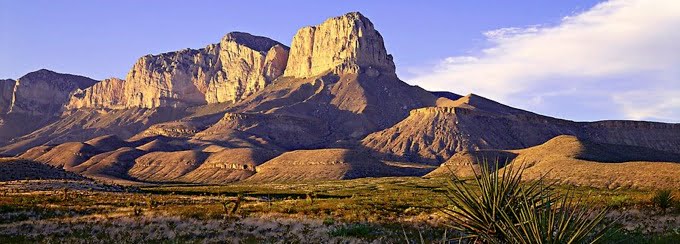
Birding at Guadalupe Mountains National Park requires time, patience, luck, and hard work. Elevations in the park range from 3600 to 8749 feet and the park boundaries encompass several life zones each with its own variety of birdlife. Desert lowlands, pine forested mountain tops, deep canyons with their riparian woodlands, and the transition zones between all of these present a variety of habitats. Because of the park�s location in the mountains of west Texas, some species found nowhere else in the state occur here. Other species are more easily found here than in the rest of the state.
The park�s checklist, available for sale through the Natural History Association bookstore, includes 303 species with 8 additional hypothetical species. Many of these only migrate through the area and may be present for only a few days a year, but at least 95 species have been known to nest in the park. Many other species winter in the area.
The Headquarters Visitor Center at Pine Springs is located at 5700 ft in a high desert transition zone. This is a good place to begin your birding activities. The two birds most commonly seen in this area, as in much of the park, are the Canyon Towhee and the Rufous-crowned Sparrow, both of which are relatively tame, conspicuous, and present all year. Both Eastern and Western Meadowlarks also occur here.
The junipers and pines between the Visitor Center and the campground are good places to look for the Juniper Titmouse (formally part of the Plain Titmouse) which can be found nowhere else in Texas. Other common year-round birds include Northern Mockingbird, Western Scrub Jay, White-winged and Mourning Doves, Scaled Quail, and Ladder-backed Woodpecker. In summer look for Scott�s Oriole, Say�s Phoebe, and, overhead, White-throated Swifts, and Turkey Vultures. The latter are, by far the most common large soaring bird seen in the park. On summer evenings, watch for Common (and occasionally Lesser) Nighthawks and listen for the soft call of the Poorwill. In winter, look for flocks of Western, Mountain, and, occasionally, Eastern Bluebirds, American Robins, Pyrrhuloxia,and Cedar Waxwings.
Another excellent birding location in this area is Frijole Ranch and the trail to Smith and Manzanita Springs. The large trees around the ranch and the water at the springs attract many species. In summer look for Summer Tanagers and Cassin�s Kingbirds.
The trail into McKittrick Canyon offers good hiking and excellent birding. The 3.4 mile trail leads from the desert into a deciduous woodland of maple, oak, walnut, and Texas madrone. The lower part of the canyon is an excellent place to find the Gray Vireo during the early summer. Look too for Ash-throated Flycatchers, Spotted Towhees, Bushtits, and Bewick�s, Rock, and Canyon Wrens. Inner canyon nesting species include Western and Hepatic Tanagers, Black-headed Grosbeaks, Grace�s Warbler, Solitary Vireo and Cordilleran Flycatcher. Watch overhead for Peregrine Falcons which nest on the cliffs at the upper end of the canyon. This is also the best area to find Band-tailed Pigeons.
The desert lowlands of the park, most easily accessible via the Williams Ranch 4-wheel drive road offer challenging yet sometimes rewarding birding opportunities. Several species of sparrows, Verdin, Roadrunners, and Cactus Wren�s are only a few of the desert dwellers. Look also for flocks of Lark Buntings and for the Loggerhead Shrike, American Kestrel, and Prairie Falcon.
A strenuous four mile hike up the Tejas Trail from Pine Springs takes you into the Bowl. Here a forest of Douglas fir and western white and ponderosa pine provides a whole different habitat for montane species such as Mountain Chickadee, Steller�s Jay, Red-breasted and Pygmy Nuthatches, Red Crossbill, and Hairy Woodpecker. Here, too, you can find wild Turkey and several species of owls.
Dog Canyon on the north side of the park is a good place to find hummingbirds and Acorn Woodpeckers and provides easier access into the park�s high country.
Enjoy your birding at Guadalupe Mountains National Park, but help them also to manage the birds and their habitat by reporting your observations to park personnel and writing up you findings on wildlife observation cards available at the Headquarters Visitor Center, Dog Canyon Ranger Station, or contact stations at Frijole Ranch or McKittrick Canyon.
More than 60 species of mammals occur in Guadalupe Mountains National Park, but most park visitors will see only a few of these. In fact, many visitors will see none. The reasons for this are relatively easy to understand. Most mammals are active during the night, or during the twighlight hours of dawn or dusk. During the day they lay up in dens or shaded areas to conserve moisture and avoid predators.
By far, the most commonly seen mammal is the mule deer which are abundant throughout the park, active during much of the day, large and conspicuous, and accustomed to the presence of humans. They are often seen around the Headquarters Visitor Center and campgrounds as well as on most trails. They regularly feed along the shoulders of U.S. 62 / 180 and are all to frequently victims of fatal encounters with passing vehicles.
The only other large mammals likely to be seen by visitors are elk. Perhaps 30 - 70 Rocky Mountain elk live in the park, descendants of a herd introduced in the late 1920s. Look for elk along the highway between Guadalupe Pass and the Frijole Ranch, especially in the early morning hours. They are also often observed along the entrance road to McKittrick Canyon. Mountain lions and black bears are present in the park, but are rare and seldom seen.
Smaller mammals occasionally seen by visitors, usually along the highway, and usually at night, include coyotes, jack rabbits, desert cottontails, ringtails, and gray foxes. Rock squirrels are common throughout the park and are sometimes seen around buildings and on rocky outcrops along the trails. Several species of bats may be observed at dusk.
The presence of mammals is most often detected by signs they leave behind; tracks, scat, rubbings and diggings. Pay close attention as you hike throughout the park and you just might see some of these signs or even get a glimpse of the elusive creatures who leave them behind.
Felidae - Cats
Mountain lions (Felis concolor), or cougars, roam throughout the Guadalupe Mountains. Although they have occasionally been spotted near the campground or along one of the trails, your chances of seeing one of these secretive, nocturnal animals are rare. Male cats may grow from 5 to 9 feet including the tail, stand two and a half feet tall, and weigh 125 to 200 pounds. Despite their large size they are very fast and very agile. Males are solitary and require large territories (10 to 20 square-miles represents a common range.)
Female cats raise a litter of 2 to 5 young. The kittens, born primarily in late winter or early spring, remain with their mother until around two years old.
Mule deer are their favored food, though in times of scarcity they may also eat rodents, rabbits, porcupines, and javelina. The reclusive behavior of cougars and their tendency to live in remote areas explain why we know relatively little about these graceful cats. They once ranged from northern Canada through South America and from coast to coast. Probably no other land mammal in this hemisphere had a more extensive range. Due to hunting and habitat loss, mountain lions have been primarily restricted to the west since the 1920s.
For many, the cougar is the symbol of wilderness, a large animal ranging freely in wild areas, independent of human interference. Mountain lions are the largest carnivore in the Southwest. At the end of food chain they serve as an indicator of ecosystem's health.
Bobcats (Felis rufus) are larger than domestic house cats, and can be identified by their yellowish-gray or tan coats that sport dark spots and black tiger stripes. They have a very short tail, and noticeable ear tufts. Ordinarily, a bobcat will spend most of the day in a well hidden retreat among the rocks or in the brush; their activities are mainly nocturnal.
Bobcats are capable of fast speed, but only for a short distance and therefore rely on patience not pursuit to catch prey. Their keen eyesight, hearing, and sharp claws allow them to catch cottontails, jackrabbits, rodents or insects for food. Females have one litter per year of 2 - 4 kittens, and raise their young without the help of the males. Males may kill the young, a habit associated with the cat family.
Bobcats and mountain lions are the only felines native to the Guadalupes.
Canidae - Dogs
The Gray Fox (Urocyon cinereoargenteus) as the name suggests wears a beautiful gray coat that is orange or red at the sides. This fox has a large bushy tail with a black tip. The gray fox prefers a habitat that has both open meadows and forested areas.
Their diet consists of rodents and other small mammals, birds and bird eggs, amphibians and reptiles. Like bears and coyotes, it is omnivorous and also eats berries, cactus fruits, and various tubers. The gray fox patiently waits for ambush as it lacks speed for pursuit. It is the only American canid with climbing ability and occasionally forages and takes refuge in trees.
Coyotes (Canis latrans)are common and widespread throughout the park. Physiologically, they have adapted well to the heat and arid conditions of the desert. Desert coyotes weigh only about twenty pounds and have much shorter and thinner fur which allows them to dissipate excess heat easier. Their fur is paler in color and helps to camouflage them with the desert surroundings.
In feeding, the coyote is an opportunist, eating rabbits, mice, squirrels, birds, lizards, insects and carrion, in addition to a variety of plants. Coyotes work together in small packs when hunting larger game, but hunt alone or in pairs when scavenging otherwise. They are the best runners among the canids. They can cruise normally at 25 - 30 mph and leap 14 feet.
The famous coyote "song", the quick yaps followed by the long drawn out howl, brings these animals together before or after a hunt. Coyotes may often be heard during the night.
The Kit Fox (Vulpes macrotis) is the smallest member of the canid family. It weighs only about 5 pounds, and is about the size of a house cat. Kit foxes are yellowish-gray above, with lighter underparts, and white under the throat. The tail is tipped in black.
Both males and females raise the young. A litter of three or four is born in early spring. The male kit fox is dedicated to his mate and consistently brings food to the young as soon as they are weaned. If the female is not present the male may raise the young alone.
Kit foxes are well adapted to the heat and dry conditions desert. These nocturnal animals live in cool, underground burrows. They hunt at night for rodents and rabbits using cat-like agility and speed to catch their prey. They have large eyes and ears that allow them to "see" in the dark. Like the jackrabbit, their large ears also help dissipate excess body heat.
Ursidae - Bears
The family�s only member in the Guadalupes is the Black Bear (Ursus americanus). This beautiful animal was once widespread throughout the state, but now remnant populations exist only in the mountainous regions of the Trans-Pecos.Though scat or tracks of bears may be seen in the high country, the animal itself is rarely ever seen. Unable to cope with human impact, black bears are shy and reclusive.
Bears do not hibernate and here some do not even den. The lack of snow during most of the winter enables them to find enough food. Their diet is extremely varied; they are known to feed on the nest contents of wild bees and ants, insects, many types of berries, pine nuts, acorns, grasses, fish, roots and tubers, carrion, and small rodents.
Bears breed in June or July. The cubs, usually two, are born in late January. They weigh 8 ounces when born and stay with their mother for the first two years.
Mustelidae - Weasels
The Badger (Taxidea taxus) could be mistaken for a large rodent because of its burrowing habits, but in fact is a member of the weasel family. Badgers possess the irritability and predatory nature of that family. Badgers are broad heavy animals with short legs. Their front feet have long, sharp claws. Badgers have course yellowish-gray body fur. A distinctive white stripe runs from the nose across the back of the head to the shoulders, and they have white stripes along their cheeks.
Like skunks and weasels, badgers have glands which produce a potent and repugnant odor. Their scent, sharp teeth, dangerously sharp claws, loose skin and threatening disposition allow them to defend against enemies.
Badgers prey on large rodents, using their claws to easily dig into most burrows. They will also prey on ground-dwelling birds, and their eggs as well as reptiles and insects. Badgers have been known to cooperate with coyotes for survival. While the badger has outstanding digging ability, it is too slow to catch anything that has the chance to run. As a team, the badger does the digging, the swiftness of the coyote assures the capture of the prey that is shared by both animals.
Striped Skunks (Mephitis mephitis) and Hog-nosed Skunks (Conepatus mesoleucus) are common in the park and are widespread in distribution, while Spotted Skunks ( Spilogale gracilis) live primarily in desert habitat and are uncommon. All three are dark in color (black or dark brown), with striking white stripes. The striping pattern of each is distinctive.
The diet of striped and spotted skunks may consist of small rodents, eggs of ground nesting birds, cactus fruits, and insects. The hog-nosed skunk is a rooter, whose diet consists mainly of insects. Its long, pig-like snout and long claws are well adapted for digging beetles, grubs and worms.
When threatened, skunks release a powerful and repugnant scent that is secreted by glands near the base of the tail. This odor is usually enough to repel any of their natural enemies. Although sometimes feared, skunks use their repugnant musk spray only when threatened.
Skunks are nocturnal and all one may spot is a ghostly white stripe moving around.
Procynoidae - Raccoons
Raccoons (Procyon lotor)can be recognized by two outstanding characteristics, a black mask and brushy, ringed tail. Raccoons are common in the park near the riparian areas. Dependent on the running water, they do not stray far from it.
Raccoons like to den in trees, but if suitable locations are not available they may also use rock crevices. Adults commonly share the den with young who are able to forage on their own, making for crowded living conditions. A litter of one to seven is born in April or May. Baby raccoons are raised entirely by their mothers.
Raccoons are nocturnal and omnivorous. After dark they search for food primarily near running streams. Their diet includes fish and frogs, but they may also eat mesquite beans, cactus fruits and berries. If other food is not available, they may prey on rodents and other small game.
Raccoons have remarkable dexterity and use their feet to wash food and for climbing. Their tracks are very distinctive; they look like a tiny child's footprint.
The shy Ringtail (Bassariscus astutus) reminds us of a cat with a very long bushy tail, alternately black and white banded. Strictly nocturnal, ringtails are rarely seen in the daytime. Instead they are asleep in the semi-darkness of a rock crevice or may hide in a hollow branch of a tree. They have large ears and eyes, well adapted to their nighttime hunting activities.
Ringtails prefer rocky habitats, especially along the cliffs of desert canyons. They move with ease along the ledges and crevices while searching for food. Their diet is varied and includes rabbits, squirrels, rodents, snakes, lizards, frogs, scorpions and centipedes, but may also include native fruits and berries. Scat observed along the trail that contains red berries, is usually that of a ringtail.
Sciuridae - Squirrels
The forest-dwelling Gray-footed Chipmunk(Tamias canipes V. Baily) occurs in Texas only in Guadalupe Mountains and in the Sierra Diablos. Its favorite habitats are stands of mixed timber (oaks, pines, and firs) and brushy slopes where rocks offer retreat from potential enemies.
Its diet includes fir and pine seeds, acorns, berries, mushrooms, and insects.
In the lower desert, the Texas Antelope Squirrel (Ammospermophilius interpres) can be spotted running with its tail held over the back, exposing white underparts. The characteristic habit of carrying the tail over the back gives us a good field identifier. This small, round, ground squirrel has one narrow white stripe on each side of the back from the shoulder to the rump.
According to its habitat, the antelope squirrel feeds mainly on fruits and seeds of cacti and other succulents. Antelope squirrels are one of the few mammals that are able to remain active in the heat of the day. When they retreat to the shade they lay "spread-eagle" with their bellies exposed to the cooler ground. This enables them to quickly dissipate excess body heat, while maintaining a safe body temperature.
Breeding begins in February, and one litter of 5 to 14 is reared each year. It is possible for a mother to raise a second litter. The babies remain with their mother until they are about one quarter grown, then they begin foraging on their own.
The Rock Squirrel (Spermophilus variegatus) is the largest ground squirrel in its range. It is a uniform gray color without stripes. As the name implies, the rock squirrel prefers open rocky areas such as canyons and washes. It is most active in the early morning and late afternoon, and may be seen sitting on rocks. Rock squirrels are good climbers and forage in trees for fruits and seeds. Their sharp teeth and claws allow them to climb even the native agave stalks to reach the seed pods. In lower elevations they frequent the edges of canyons where the black walnut grows. Rock squirrels are voracious eaters. Other foods in their diet include acorns, pine nuts, mesquite beans, cactus, and saltbrush . Insects contribute to their diet too, and they are fond of flesh, such as small birds.
Spotted Ground Squirrels (Spermophilus spilosoma) are uncommon in the park and seldom seen. These squirrels are extremely shy. They are most active in the early morning or late afternoon and retreat to underground burrows to avoid the heat of the day. They don't stray far from their burrows, which provide protection from predators. Spotted ground squirrels prefer a dry and sandy habitat. They can be identified by scattered, small, square, light spots on their backs. Their fur is a light gray or light fawn color, with white underparts.
Spotted ground squirrels eat green vegetation and seeds, specifically, cactus, mesquite beans, or saltbrush seeds. They also eat grasshoppers and beetles.
Leporidae - Rabbits
Desert Cottontails (Sylvilagus audubonii) are small animals with short ears and a white tail. Desert cottontails are common and abundant throughout all of the southwestern states. Though their enemies include many carnivores and most birds of prey, their populations do not seem to diminish. They are able to adapt to a variety of conditions, and mothers have several litters each year.
In the Midwest, cottontails live in the thick underbrush. They make nests in hollows and line them with soft grass. In the desert though, the extreme climatic conditions force them to live in underground burrows. These burrows insulate them from the heat, and keep them safe from predators.
Though cottontails are fast, they escape by dashing in a zigzag pattern that confuses and tires their pursuers.
Black-tailed Jack Rabbits (Lepus californicus) are common in the lower elevations of the park. The black-tailed jack rabbit is really a hare, and is easy to identify by its long ears with black tips. It has a black stripe on the tail that extends onto the rump.
Jack rabbits avoid desert heat by spending much of the day in the shade and protection of the shrubs. Female jack rabbits make a scratched-out nest for their young in the brush. This nest also provides shelter in the winter months.
Jack rabbits are most active at dusk, and continue feeding well into the night. Their large ears and eyes are well adapted to the darkness. Their large ears also dissipate excess body heat. Jack rabbits eat cactus, sagebrush, mesquite and numerous grasses and herbs.
Their natural enemies include, large birds of prey and carnivores such as coyotes, badgers, foxes, and weasels. Unlike cottontails that may "freeze" as a predator nears (and run only after knowing they have been spotted), jack rabbits rely on speed and keen senses of hearing and eyesight to avoid their enemies.
Cervidae - Deer
Mule Deer (Odocoileus hemionus) are very common in the park. They have large ears which move independently, and give this species its name, hemionus, or "burro." Because they are often seen both in the park and the surrounding vicinity, one may conclude that their numbers are not suffering. They have, however, been declining since the 1960's. This decline may be natural in part, but certainly has been influenced by hunting (and over harvesting), loss of habitat to livestock, and reduction of available browse.
Mule deer are larger in size than Sonora white-tailed deer. They can be further distinguished by their large ears and short-haired, whitish tails, that have black tips. Mule deer bound through the desert scrub when scared; a characteristic not shared by white-tailed deer.
Mule deer are browsers. They prefer the leaves and twigs of shrubs to grasses. They nibble only a little from each plant, thus allowing individual plants to remain healthy. Also by constantly moving around, mule deer aren't as vulnerable to predators. Their coloration provides excellent camouflage, as they blend in perfectly with the drab desert colors.
A group usually consists of a doe with her fawns and yearlings. They are easily spotted along trails, especially near water.
Elk (Cervus merriami) native to this area, lived only in the southern part of the Guadalupe Mountains. But by the turn of the century, they had been hunted into extinction. In 1928, rancher J.C. Hunter imported 44 Elk (Cervus elaphus Erxleben) from the Black Hills of South Dakota and released them in McKittrick Canyon. Initially they multiplied, and began moving throughout the mountains. By 1938 the population was estimated at 400. In 1959 elk were added to the list of game that could be hunted. Today the population is estimated to be under 40 animals.
In spite of their large size, elk are surprisingly agile. When frightened, they will run full speed a short distance, regroup, and if necessary continue at a trot, usually single file. At this pace, they can continue for several hours. Though their senses of hearing and eyesight are well developed, it seems they rely heavily on their keen sense of smell to detect danger.
Elk are both grazers and browsers. Shrubs such as mountain mahogany, ceanothus, agaves and several species of grass provide their food.
The males shed their antlers each year beginning in February, and new growth begins shortly after the scars are healed. Point size for elk antlers is generally five or six.
Bugling signals the beginning of mating season. Dominant bulls group with their harems of five to fifteen cows. The cows are drawn to the bulls as they come into heat. A single calf is born to the cow at 8 1/2 months. Though very helpless for the first few days, a calf begins eating grass at the age of one month. Females reach sexual maturity in their second year, while males begin actively rutting in their third year.
Dicotylidae - Peccaries
Javelinas (Dicotyles tajacu) are small, dark, pig-like animals with coarse salt and pepper colored fur. A lighter band of hair around the neck gives us the common name "collared peccary." Both sexes grow tusks and have a large musk gland on their back near the rump.
Javelinas feed on shrubs, grasses, mesquite beans, cactus, and roots or tubers. They prefer habitat that allows them to hide amongst the thick brush, which provides shade and cover from predators. Javelinas feed in loose groups, the babies always near the mothers. At the first sign of danger, they remain perfectly still but release strong musk from their glands, a repellent to many predators. If cornered, they will often charge, but may also flee in every direction.
Other Mammals
The park provides suitable habitat for 16 species of bats, including two species of free-tailed bats. Bats are nocturnal, shy, and small in size, making observation difficult. Relatively little is known about hundreds of species.
Bats are the only true flying mammals. They are well adapted for flying with lightweight bones and a thin skin membrane that makes up the wing. When flying, they can reach an altitude of 10,000 feet. At that height they take advantage of tail winds to fly at speeds in excess of fifty miles per hour.
As winter approaches and insects become scarce, many species of bats such as the Brazilian free-tail bats (Taderida brasiliensis), migrate south for hundreds of miles, remaining within milder climate zones. Other species hibernate throughout the winter; some remaining in large colonies in caves, abandoned mines, or under bridges, while others hibernate singly in cracks and crevices in the rocks or in trees. During hibernation, a bat's temperature may drop to near freezing and metabolism slows dramatically allowing reserved fat storage to sustain their survival for many months.
Though most southwestern bats are insectivorous, some like the Pallid bat (Antrozous pallidus) eat lizards and small rodents in addition to scorpions and other insects. Bats normally use echolocation (the transmission of high frequency sounds that bounce back to their sensitive ears) to locate objects and food. Contrary to popular myth, bats are not blind and also use sight and smell to aid in catching prey.
Of the mice, rats, and pocket gophers that inhabit different areas of the park, many species are uncommon, and most are never seen. Underground, protected burrows and nocturnal habits allow them to survival harsh desert conditions and keep them safe from predators. The Botta's pocket gopher (Thomomys bottae) spends 90% of its time underground, living in an extensive burrow system that has main galleries and many side chambers. The side passages are used for food storage and fecal waste. Tunnel systems commonly can be more than 150 meters in length. In winter the tunnels may extend into snow, allowing the gophers to forage for food above ground in safety.
The Banner-tailed kangaroo rat (Dipodomys spectabilis) is a large, four-toed kangaroo rat that has a long tail with conspicuous black stripes and distinctive white tuft. If caught by the tail, the tuft will break off and be regrown. Banner-tailed kangaroo rats can survive without any water, thanks to an outstanding metabolism, and behavioral adaptations to harsh desert conditions. Their kidneys concentrate salts and urea ten to twenty times, reducing moisture loss through urination. When they exhale, their breath is cooled by elongated nasal passages, allowing them to recapture the moisture. Kangaroo rats forage at night, when temperatures are cooler. They collect seeds in their cheek pockets, but return to underground burrows before feeding. By remaining underground much of the time they avoid predators such as badgers, foxes. coyotes and bobcats. If pursued their swiftness and agility makes them a challenge for any predator.
Banner-tailed kangaroo rats build large mounds with multiple openings, and intricate galleries. The large mounds of these rats are unmistakable. They are generally found on rocky slopes with creosote and acacia.
Within the park boundaries, two exotic species may occasionally be seen: Barbary sheep (Ammotragus lervia) and Mouflon sheep (Ovis spp). Introduced by sheep ranchers, they remain in the montane areas.
Snakes - suborder Serpentes
The Bullsnake (Pituophis melanoleucus) is the most frequently seen snake in the park. It lives both in desert flats and in the Bowl. As with most snakes, it is active in the early morning and late afternoon. The Coachwhip (Masticophis flagellum) may be found from desert lowlands and grasslands to the base of the escarpment. This fast snake avoids areas of dense vegetation and hides in underground burrows if disturbed. The Mountain Patchnose Snake (Salvadora grahamiae) lives in rocky areas and canyons at intermediate elevations. This common snake was believed to use its patchnose for burrowing.
Rattlesnakes
Five species of rattlesnakes occur in the park. The largest is the Western Diamondback Rattlesnake (Crotalus atrox), frequently seen on McKittrick Canyon Road and rocky washes in the lowlands. The attractive Black-tailed Rattlesnake (Crotalus molossus) is usually found on slopes, particularly at higher elevations. It is the most commonly seen rattlesnake in the park. The highly toxic Mojave Rattlesnake (Crotalus scutulatus) occurs in the William's Ranch area and surrounding creosote bush flats. The Rock Rattlesnake (Crotalus lepidus) prefers rocky areas in the highlands. A rare inhabitant of the grasslands at Dog Canyon is the Prairie Rattlesnake (Crotalus viridis). Rattlesnakes are highly venomous, but they reserve their poison for prey unless threatened into a defensive action. Make sure to allow plenty of space for the snake to escape if you encounter one of these beautiful reptiles.
Rattlesnakes are fascinating and beautiful animals. Their venomous bite, although rarely fatal & used only for feeding and defense, commands respect & common sense in their presence.
To avoid being bitten:
If you see a rattlesnake in your campsite contact a ranger. The chances of being bitten are EXTREMELY low. If however you are bitten by a rattlesnake:
DO NOT:
DO:
Take some time to learn about rattlesnakes and other reptiles. Perhaps if you are lucky you will see or hear one during your travels. Rattlesnakes are protected in national parks but often are not on other public lands. With some knowledge & understanding of the biology of rattlesnakes, you will know how to react when you encounter one of these remarkable animals.
Lizards - suborder Sauria
Numerous lizards inhabit the Guadalupe Mountains from the desert to the high forest. The most commonly seen lizard in the park is the Prairie Lizard (Sceloporus undulatus). As a good climber, it lives between rocks, in sotol, shrubs and trees.
Look for the Chiuahuan Spotted Whiptail (Cnemidophorus exsanguis) near its burrows along the Smith Spring Trail. All members of this species are females and thus reproduction is by asexual means. This leaves a new generation to be an exact clone of the mother.
The Mountain Short-Horned Lizard (Phrynosoma douglassi) blends perfectly with surrounding rocks and it is well protected by numerous spines along its neck and sides.
Collared Lizards (Cratophytus collaris)can be spotted running for refuge. Its distinctive black band on the neck gives its name. Lizards are diurnal, and though most blend in well with their suroundings, their daytime activities and quick movements make them much easier to spot than other wildlife in the park.
Turtles - order Testudines
The only common member of the order testudines (turtles) in the park is the Western Box Turtle (Terrapene ornata), a terrestrial burrowing species. It is most active in the morning or after heavy rainfall. Often it will remain underground during the intense heat of summer days, and hibernates in the cold winter months. Box turtles eat a variety of insects, including beetles, but they also like berries and carrion. Male turtles have red eyes, while females can be identified by their yellow eyes.
Amphibians
Though water is rare in these desert mountains, a few amphibians occupy the niches. TheCouch's Spadefoot (Scaphiopus couchi) is a burrowing toad of the desert lowlands and can be seen on the McKittrick Canyon road on rainy nights.
Burrowing under rocks near water sources in McKittrick Canyon, Pine Spring Canyon and Shumard Canyon one may find the Red-Spotted Toad (Bufo punctatus) as well.
The Rio Grande Leopard Frog (Rana berlandieri) lives near spring fed pools, such as in McKittrick Canyon, at Manzanita Spring, Smith Spring and Choza Spring.
Many spiders are found in the park; one is the large but harmless tarantula. Millipedes and centipedes are mostly commonly observed in the desert areas, together with several kinds of scorpions. Of the insects, the grasshoppers are among the most conspicuous; a dozen species may be found, including Lubber grasshoppers and praying mantids. Beetles are abundant and often colorful. Many butterflies fill the air in the canyons, yellow tiger swallowtails are often seen. Ants, wasps and bees are also part of the ecosystems.
Prickly Pear - Opuntia engelmannii
is a widespread cactus of the southwest. It has greenish flattened pads or stems joints that vary in size and habit of growth. Spines and glochids (tiny barbed hairs) are numerous and typically white or gray with dark tips. Flowers are large and spectacular, typically yellow, with many petals. The oval fruits are red purple and juicy. The fruits, called tunas, are edible and used in cactus jelly. The young pads, or nopals, are also edible. There are ten varieties of Prickly pear in the park.
Claret Cup Cactus - Echinocereus triglochidatus is found among the pinyons and junipers on rocky slopes and in grasslands between 4000 ft and 7500 ft. The fleshy green stems are cylindrical and up to 12 inches tall with 5 to 15 parallel ribs. These spiny stems form clumps or mounds and produce red, 2 inch wide, funnel-shaped flowers in the spring. The fleshy red fruit is edible but spiny.
Ocotillo - Fouquieria splendens found on rocky hillsides below 5000 ft, is well adapted to desert life. Clumps of long, branched stems that arise from a central crown appear dead during the dry season. However, after a good rain, leaves cover the thorny, green-brown stems and last until it is once again dry. Bright, red, tubular blossoms appear at the tips of the stems in dense clusters. Their nectar is an important food for hummingbirds. Early settlers used the thorny stems to create living fences and animals pens.
Cane Cholla - Opuntia imbracta
is a branching, cylindrical-jointed cactus of desert shrub and hillsides, typically 5 to 6 feet in height. The joints are usually green, up to 12 inches long and covered with cream or brown spines. The showy magenta flowers are 2 inches in width. At a distance the dry yellow spiny fruit is often mistaken for flowers. When the cholla dies, hollow, woody cores with diamond-shaped holes remain. This skeleton is often made into walking sticks or used for ornamental curios.
Century Plant - Agave neomexicana or mescal, was the main food source for the Mescalero Apaches, who once roamed this area. It grows on rocky slopes and hillsides in the desert foothills. The compact rosette of blue-green leathery leaves is tipped with dark spines. The upper half of the leaf margins is covered with grayish hooked teeth. After 15 or more years (but not a century) a flower stalk about 12 feet high with 10 to 15 lateral branches arises from the middle of the rosette. The umbrella like clusters of red buds and yellow flowers attract many nectar-loving species. Once the seeds ripen, the plant is dead. Agaves are the source of the alcoholic beverages pulque, mescal and tequila.
Lechuguilla - Agave lechuguilla, the indicator plant of the Chihuahuan Desert, often grows in extensive colonies below 4500 ft. Leaves are many times longer than they are wide. They form a rosette of yellow to gray-green, spine-tipped daggers, which are hazardous to walk through. Leaf margins bear sharp, downward curved spines. Like all agaves, the plant requires many years to store sufficient food for production of its 10 foot flower stalk which grows at an amazing rate. The leafless stalk supports pale yellow flowers in narrow spine like clusters. Three-celled fruits ripen and produce many tiny, flat, black, shiny seeds. Soon after, the plant dies; its life cycle complete.
Soaptree Yucca - Yucca elata
, the New Mexico state flower, is the most common yucca in this area. The definite, often branching trunk terminates in a clump of numerous, spine-tipped leaves. The cluster of white, bell shaped flowers rises on a stalk above the leaves. If the yucca moth fertilizes the flower, a dry capsule eventually develops with paper-thin seeds. The roots, or amole, were used by Indians and early settlers for soap.
Faxon Yucca, Spanish Dagger - Yucca faxiona is a large (to 40 feet tall) yucca of the high desert plateau of West Texas. Leaves up to 4 feet long are born in dense heads 5 to 7 feet in diameter. Leaf tips bear a short dark spine; leaf margins have gray or brown fibrous threads. The bark of the huge stem is reddish-brown and often covered with dead curled leaves. White flowers are in dense clusters, usually partially hidden by the leaves. Fruit is a bitter tasting, fleshy capsule about 4 inches long and 1.5 inches wide that darkens as it matures. The largest faxon yucca in the United States is located in the Guadalupe Mountains National Park.
Sotol - Dasylirion wheeleri, found in grassy areas above 3500 ft, grows close to the ground with a thickly woody stem below. The numerous ribbon like leaves are flat with yellow-brown spines on the margins. Flowers are numerous and unisexual, borne in a large narrow spike on a leafless stalk, 10 to 12 feet tall. A powerful alcoholic drink also called "sotol" is made from this plant.
Nolina, Beargrass - Nolina microcarpa is confined to exposed locations on rocky slope above 3000 ft. Beargrass looks like a huge clump of long-bladed grass, with flexible, narrow leaves up to 3 feet long with finely serrated margins. The plumelike cluster of white flowers is nested among the leaves. The three-lobed fruit capsules are papery and dry-winged, and remain on the stalk until late fall. Indians used the leaves in weaving baskets, mats and other household items.
Apache Plume - Fallugia paradoxa is a scraggly, clump-forming shrub found between 4000 ft and 8000 ft in rocky or sandy soils along roadsides, canyons, and arroyos. The small wedge-shaped leaves of this partially evergreen shrub are divided into 3 to 7 blunt-tipped lobes. Conspicuous white flowers are present all summer. Fruits are feathery balls often tinged with red or pink. The fruit reminds some people of an Indian feather bonnet, hence the common name, apache plume.
Agrito, Algerita, or Barberry - Berberis sp.
is an evergreen shrub with stiff, spiny, holly-like leaflets on alternate, compound leaves. The yellow flowers grow in small clusters and yield a small reddish berry in the fall. A yellow dye can be extracted from the stems, and jelly is made from the berries. Three species are found in the park.
Mexican Orange - Choisya dumosa is an aromatic, evergreen shrub of the canyons and hillsides, that grows between 3000 ft and 7000 ft. The unique, palmately compound, opposite leaves have 5 to 10 narrow, coarsely toothed, gland-dotted leaflets. Flowers are solitary or in small clusters with 5 white petals. Young twigs are green and hairy, becoming gray and warty with age. This shrub is a member of the citrus family, but the fruits are not edible.
Desert Ceanothus or Desert Buckthorn - Ceanothus greggii is associated with rocky and often brushy slopes above 2000 ft. This heavily browsed, thorny shrub is seldom more than 4 ft in height. Leathery and opposite, the gray-green leaves are finely toothed and semi-evergreen. The tiny, white, fragrant flowers are produced in small axillary clusters. The berrylike fruit is green and three-lobed, turning reddish brown as it ripens.
Mountain Mahogany - Cercocarpus montanus is a slender-stemmed shrub of dry rocky areas found at elevations above 3000 ft. Simple oval leaves are about 1 inch long with distinct veins and coarse-toothed margins. The tiny flowers lack petals, but the sepals form a greenish tube that holds the many stamens. In autumn, fuzzy, spiral tails 1 to 3 inches long are found on the small seeds.
Skunkbush, Squawbush, or Desert Sumac - Rhus trilobata is a heavily browsed shrub found above 3500 ft. Leaves are alternate and compound with three lance-shaped, toothed or lobed leaflets. Tiny flowers with yellow petals appear in dense clusters before the leaves develop. The reddish-orange, hairy berries are used to make a lemonade-like drink. Indians used the stems in basket making. The leaves turn red in fall and are aromatic when crushed.
Evergreen Sumac - Rhus virens an evergreen shrub of rocky hillsides and cliffs, is found above 2000 ft. The alternate, compound leaves are leathery with 5 to 9 leaflets and entire margins. Tiny white flowers appear in clusters after rains. The reddish fruit is covered with short hairs and used to make a lemonade-type beverage.
Catclaw Acacia - Acacia greggii is found between 3500 ft and 5000 ft along streams and arroyos and in canyons. This shrub or small tree often grows in almost impenetrable thickets. Leaves are bipinnate with 2 to 6 pinnae each and 4 to 14 oblong, prominently nerved leaflets. Flowers are cylindrical, yellow, and grow up to 1.5 inches in length. Seed pods are flat, linear, and irregular constricted between seeds. Spines along the branches are curved back like the claws of a cat, hence the name.
Creosotebush - Larrea tridentatais one of the most long-lived and abundant desert plants of North and South America. It is often found in pure stands. The small, leathery, evergreen leaves occur in pairs united at the base. When it rains, five-petaled flowers appear and the air is permeated with the fragrance of creosote bush. The fuzzy white seed balls are relished by rodents. When crushed, the resinous leaves smell like the petroleum by-product, creosote.

Bigtooth Maple - Acer grandidentatum occurs in canyons and moist soils of the mountains of Arizona, New Mexico, and west Texas. The tree may grow to a height of 50 feet. Leaves are opposite and typically 2.5, inches in diameter, with three broad, blunt lobes. Fruits occur in winged pairs called samaras. The bark is gray to light brown and may be smooth or scaly. This tree is responsible for the brilliant reds and yellows during the fall color display.
Gray (Grey) Oak - Quercus grisea, a common shrubby oak of the Southwest, grows in dry rocky sites at elevations between 4500 ft and 7800 ft. The leaves are small and oval, usually smooth margined, but occasionally toothed. They are dusty blue-gray in color, hence the name. Star-shaped hairs appear on both sides of the leaves. The acorns are small and stalked. The leaves turn brown in autumn and are retained on the twigs until new ones emerge in the spring. Oaks tend to hybridize, leading to variations in leaf form and other botanical characteristics and making positive identification of individual trees difficult. Guadalupe Mountains has seven species of oak; chinquapin and gray oak are the most distinctive.
Honey Mesquite - Prosopis glandulosa is a common and widespread desert shrub or tree usually found below 5000 ft along streams and arroyos. Root systems penetrate the soil to a depth of 60 ft; thus, there is often more wood below than above ground. The branches have sturdy, straight thorns. Flowers are catkin-like clusters of green-yellow. They are rich in nectar and attract honeybees, which produce an excellent light honey. The shiny green leaves are bipinnate with 2 to 8 pinnae each, with 12 to 60 leaflets. The fruits, which ripen in the fall, hang like string beans from the branches. Cattle eat the beans contributing to the spread of mesquite. Mesquite wood is popular for barbecuing.
Littleleaf Walnut - Juglans microcarpa occurs in southern New Mexico and west Texas along streams coming off the foothills. Trees are small and shrubby, often with several stems, typically 20 to 30 ft in height. Leaves are pinnately compound with 13 to 23 leaflets. Leaflets are narrow and long with fine teeth at the margins. The tiny walnuts, seldom more than a half inch in diameter, are gathered by squirrels and other animals.
Madrone - Arbutus texana is found on rocky slopes or canyon walls in the desert mountains of south eastern New Mexico and west Texas between 4500 ft and 6500 ft. This rain forest relict has alternate, oval, evergreen leaves up to 3 inches long. The urn-shaped flowers are white or pink and in clusters at the end of the branches. The tree, which grows to 30 ft tall, has a gnarled trunk. The reddish bark peels with age, revealing younger white or pink bark. The local name "manzanita" refers to the bright red fruit that looks like "little apples."
Mexican Buckeye - Ungnadia speciosa is a small, much-branched shrub or tree of west Texas and southern New Mexico. It grows among the rocks and in canyons. Fragrant rose-colored flowers appear before the new leaves. Leaves are compound with 5 to 7 leaflets that are up to 5 inches long with toothed margins. Two-inch brown seed pods or capsules are borne on short stalks. They are three-celled and contain one shiny black seed per cell. This tree is not a true buckeye, but is a member of the soapberry family.
Juniper - Juniperus sp. have short scale-like needles and grow in dry rocky soils in the foothills or lower mountains. The seeds are borne in scaled cones, and the scales eventually grow together to produce a berrylike structure. Cones may be blue or red, depending on the species. In addition to being eaten by animals, the "berries" are used to flavor gin. The largest alligator juniper (Juniperus deppeana) in Texas is located in the park. Three other species of junipers also grow here.
Pinyon Pine (Pi�on) - Pinus edulis grows between 5000 ft and 7000 ft, often mixed with junipers and shrubby oaks. Normally this reddish-barked tree is small and many branched. The leaves or needles, clustered in bundles of 2 or 3 are 0.75 to 1.5 inches long and dark green. The cones are about 2 inches long and contain wingless edible seeds, 0.5 inch in length. Man and animals alike relish the rich tasty seeds. One pound of pinyon nuts contains more than 3000 calories. It is the state tree of New Mexico.
Ponderosa Pine - Pinus ponderosa is typically found about 6000 ft feet but a few strays can bee seen in the lower canyons. This large tree (to 180 ft) is the most valuable lumber tree in the United States. The bark is dark brown to black in young trees, turning yellowish-red with age. To some people, the bark smells like vanilla. Needles grow in clusters of 2 or 3 and are 5 inches long. The immature cones are green and tightly closed, changing to reddish-brown as they ripen. Winged seeds are released from the cones and eaten by rodents.
The variety of wildflowers is endless. Below are descriptions of some common and pretty ones. You can view the most common ones at the park's flower gallery.
| Whites and Pinks | Yellows | Blues and Purples | Reds and Oranges |

Scarlet Gaura, Evening Primrose Family - Gaura coccinea A common perennial herb with somewhat spreading stems that are 12-18 inches long. Numerous red, pink, or white flowers bloom at the ends of stems; flowers appear frilly due to many extended male and female flower parts. This fragrant flower blooms late spring through late fall.
Nodding Onion, Lily Family - Allium cernuum It can always be recognized by the nodding umbel of pink bell-like flowers and a distinctive onion odor. The leaves are narrow and linear. Nodding onion is found in the higher elevations of the park, and blooms Jun - Oct.
Leather-Flower Clematis, Crowfoot Family - Clematis filifera Grows as a vine with segmented and net-veined leaves, and is found mostly at elevations over 4000 ft. The leathery sepals of the flowers curve upward forming beautiful deep maroon bells. Jun - Oct.
Colorado Four-O'clock, Four-o'clock Family - Virablilis multiflora Fairly common and attractive. This perennial herb grows to be a relatively large spreading bush with heart-shaped leaves. The plant produces numerous tubular rose-colored flowers in the evening. Found at the lower elevations, primarily in gyp and calcareous soils. Blooms May - Oct.
White-eye Phlox, Phlox Family - Phlox mesoleuca These beautiful but delicate flowers are a refreshing sight as winter gives in to warm spring temperatures. Five broad, bright pink petals surround a distinctive white center. There are several flowers per plant, each about an inch in diameter. Blooms from May - Oct.
Mat Bluets, Madder Family - Hedyotis sp. A compact, low bushy plant with numerous small white flowers. Each flower has four distinct petals at right angles to one another. Mar - Oct.
Blackfoot Daisy, Sunflower Family - Melampodium leucanthum This common perennial herb grows only about 6 inches tall. Its numerous white daisy like flowers have yellow centers. Many branches support the flowering heads which are about an inch across. May - Oct.
Jimson-Weed, Nightshade Family - Datura Wrightii The large white trumpet-shaped flowers are often as much as 6 inches across and quite beautiful. The plant is a sprawling bushy plant, as much as 3 feet tall and twice that wide. The leaves are broad; as much as 4-10 inches long, have fine hairs, and grow on short stems. Be careful around Datura; all parts of this plant are poisonous. Blooms at the lower elevations. May - Nov.
Dwarf Zinnia, Sunflower Family - Zinnia acerosa Flowers appear as four or five rounded white rays and six to eight tubular yellow flowers at the center of the head. This plant thrives in the limestone soil, and tends to bloom after the rains in the spring and summer. Often confused with Z. grandiflora, which looks similar, except flowers are yellow when in bloom, but fade to an ivory hue by the end of summer. Jun - Oct.

Hartweg Evening-Primrose, Evening Primrose Family - Calylophus Hartwegii A common many-branched bushy perennial with narrow leaves. It has large lemon-yellow flowers with four delicate petals and huge pollen-loaded anthers. Apr - Sep.
Chapline Columbine, Crowfoot Family - Aquilegia Chaplinei A pale-yellow flowering perennial herb that grows in shaded crevices,on boulders, and in the calcareous soil of moist canyons. Commonly seen along the water's edge in McKittrick Canyon between Apr - Nov.
James Dalea, Legume Family - Dalea Jamesii A low growing herbaceous perennial about 6 inches tall. The three-part leaves are covered with silky hairs. Small yellow pea-like flowers are embedded in short cottony heads. Frequently found in gravely soil and grama grass on the west side of the park. Jun - Sep.
Flax, Flax Family - Linum sp. This common herbaceous plant has small fragile flowers, which easily fall at the slightest touch. Depending on the species, the flower petals range from pale yellow-orange to orange, some with maroon centers. The plant has alternate leaves held close to the stem. Apr - Aug.
Showy Menodora, Olive Family - Menodora longiflora Each yellow tube flower is about 2-3 inches long with 5-6 petals that flare out flat and are pointed at the tips. Stamens are hidden within the tube. Plants grow 12-18 inches tall with several branches. The leaves are smooth, opposite, and quite narrow. Mar - Oct.
Bigleaf Greeneyes, Sunflower Family - Berlandiera lyrata var macrophylia Each flower has eight yellow ray flowers and deep maroon disk flowers at the center. The plant is a herbaceous perennial that grows to a height of 1-2 feet, and has strongly lobed leaves. Look for this plant in McKittrick Canyon among the woodland bottoms. Apr - Oct.
Curly-Cup Gumweed, Sunflower Family - Grindelia squarrosa A fairly common medium sized plant that has numerous yellow daisy flowers. The buds are sticky and rubbery in texture; leaves have very distinctly toothed margins. Jun - Oct.

Silverleaf Nightshade, Nightshade Family - Solanum elaeagnifolium A rather tall, much-branched plant with sharp, prickly gray-green stems and leaves. Flowers appear as beautiful purple stars with yellow central parts. In fall, the conspicuous fruits are small hard yellow balls. This relative of the tomato is toxic to both humans and livestock. May - Oct
Wright Verbena, Vervain Family - Verbena Wrightii This common plant is an attractive annual herb with deep purple flower clusters that often cover the whole plant. Leaves are tri-lobed with smaller terminal lobes. Though it blooms from early spring into late fall, it flourishes with summer rains.
Mealy Sage, Mint Family - Salvia farinacea This perennial herb grows about 2 feet tall and is especially attractive to many species of butterflies. The flowers are pale to deep blue; it frames the trail in McKittrick Canyon in late summer. Apr - Nov.
Bluebells, Bluebell Family - Campanula rotundifolia This attractive perennial grows about 12-18 inches tall. The flowers are violet-blue and hang as delicate little bells. Look for these beautiful flowers in the moist canyons or in the Bowl, Jun - Oct.
Wavyleaf Thistle, Sunflower Family - Cirsium undulatum This common perennial grows especially well in disturbed areas. It is a tall (1-3 feet), erect plant with large bluish-gray-green prickly leaves. Large pink to lavender flower heads appear like frilly cotton balls. Blooms May - Oct.
Dotted Gay-Feather, Sunflower Family - Liatris punctata This beautiful perennial herb has long shafts of purplish flowers and usually blooms after most of the spring and summer flowers have disappeared. It will stand conspicuously in the canyon bottoms along the McKittrick Canyon and Devil's Hall trails. Aug - Oct.

Indian Paintbrush, Figwort Family - Castilleia integra Many species of Paintbrush are partially parasitic; they rely on the roots of other plants for their water and nutrients. The bright red color we are so drawn to is actually the bracts or leaves, among which the tiny greenish flowers lay quite hidden. Apr -Oct.
Royal Beard-Tongue, Figwort Family - Penstemon cardinalis Look for bright red tube flowers that are over an inch long growing on stiff stalks. Leaves form a basal rosette; with a few straying up the stem. Found mostly in the moist canyon bottoms on limestone boulder outcrops. May - Aug.
Western Wall-Flower, Mustard Family - Ervsimum capitatum Each flower is about 1/2 inch across, has four petals, and is usually a deep orange. Flowers bloom in clusters at the end of tall, single, stiff stems. Wallflower grows in calcareous soils especially in clearings in the Bowl. Apr - Sep.
Skyrocket Gilia, Phlox Family - lpomopsis aggregata The brilliant red trumpet flowers are about 2 inches long and appear like star bursts; five pointed petals flare open exposing a speckled yellow throat and long stamens. Look for this exceptionally beautiful plant as you hike from Dog Canyon along the Tejas Trail, or in the Bowl. Aug - Oct.
Cardinal Flower, Bluebell Family - Lobelia cardinalis Tubular flowers are about 1 inch long, and are a beautiful scarlet color. Each flower is two lipped; the upper lip is deeply two-lobed, the lower is three-lobed. You will find it in semi-shaded moist areas. May - Dec.
Indian Blanket, Sunflower Family - Gaillardia pulchella The flashy flowers of this bushy plant grow on single stems, and consist of many bright red-orange petals tipped in yellow, surrounding a yellow center, which turns deep red with age. This annual herb is about 12 inches tall or less, and the flowering heads are about 2 inches across. Mar - Oct.
Copyright © 1995 - 2007 Hillclimb Media
Click Here to obtain Advertising Information on this Page
This site is in no way associated with the United States Government, the Department of the Interior or the National Park Service