|
|
|
| Butterfield Overland Mail | Establishment | Frijole Ranch | Geology |
| Guadalupe People | Size | Wallace E. Pratt | Williams Ranch |
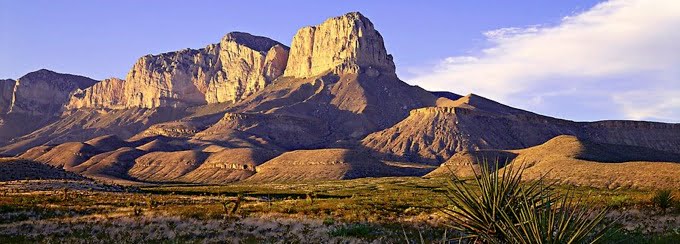
Guadalupe Mountains National Park was established on 30 Sep 1972. The park celebrated its 25th anniversary in 1997. It preserves the rugged spirit and remote wilderness of the American West. Here, in the ancient Guadalupe Mountains that tower so majestically into the Texas sky, a visitor can delight in grand views, diverse landscape, and small pleasures.
Wallace Pratt, a petroleum geologist who was charmed by the beauty and geology of the Guadalupe, purchased land in McKittrick Canyon in the 1930's. In 1959, Pratt donated his land to the National Park Service. Additional land was purchased from J.C. Hunter, and in 1972, Guadalupe Mountains National Park was created by an act of congress.
Wallace E. Pratt - a Geologist in Love with the Country
In 1921, Wallace E. Pratt accompanied two West Texas oil-lease brokers to Pecos, Texas to purchase leases for his employer, Humble Oil and Refining Company. He was the first geologist hired by Humble. While awaiting a meeting with landowners, Pratt was offered a chance to visit what Pecos attorney Judge Drane assured him was "the most beautiful spot in Texas." Pratt agreed to go, but during the trip through the barren desert scrub of West Texas, Pratt became skeptical about Drane's enthusiastic description. Pratt had nearly concluded that Judge Drane's beautiful spot referred merely to the high desert mountains; then he entered the canyon, and the beauty of the hidden woodland deep within McKittrick Canyon's walls was revealed.
In 1921, the canyon was even more spectacular than it is today. It sheltered a free flowing stream running the length of the canyon with a succession of miniature waterfalls formed when travertine deposits created dams along the watercourse. These dams were destroyed and most of the stream went underground during flooding in 1943 and 1968.
Maple, walnut, oak, and madrone grew alongside desert plants like cactus and agave, all enclosed by steep walls formed when the creek cut through the limestone of the Capitan Reef.
So unique is this spectacular canyon. While its towering walls protect the riches of diversity, its precious secrets are hidden in riparian oasis. It is no wonder that it has been described as the "most beautiful spot in Texas." But for all its magical power that delights thousands of people each year, its fragility reminds us that our enjoyment cannot compromise its necessity for survival. It must survive - not for us, but for all that lives within.
According to archeological evidence unearthed in and near the canyon, the earliest inhabitants occupied the area over 12,000 years ago. Only stone-chipped tools, bone fragments and bits of charcoal remain to reconstruct the ways of their lives. More recent discoveries, such as mescal pits and pictographs, help weave a more complete story of prehistoric life in the Guadalupes.
Much later in history, around the early 1500s, the Mescalero Apaches inhabited the canyon. The Guadalupes provided the riches of game, water, and shelter, and remained their unchallenged sanctuary until the arrival of settlers, cattle drovers, and stage lines. As the land was taken from the Indians, conflicts arose. Skirmishes turned to bloody battles. Settlers demanded protection. The Mescalero were forced from the area as cavalry troops penetrated the Guadalupes, raiding and destroying Apache rancherias, rations and supplies. By the late 1800s, nearly all of the surviving Mescalero Apaches in the U.S. were on reservations.
Eventually the rugged land was tamed for ranching and farming. Grazing and hunting activities took their toll as fences went up. Wildlife disappeared - Meriam elk, Desert bighorn sheep and Blacktail prairie dogs disappeared from the Guadalupes. Though settlement occurred slowly in the Guadalupes, people were here to stay. McKittrick Canyon was named for Captain Felix McKittrick, a rancher who moved to the mouth of that canyon in 1869.
On the return trip to Pecos, Judge Drane told Pratt that the McComb's Ranch containing part of McKittrick Canyon was for sale. Pratt acquired a quarter interest for a summer vacation getaway. His partners were interested in a place to entertain clients on deer hunts, but Pratt recognized the uniqueness of the canyon. When the stock market crashed in 1929, Pratt bought out his partners and by 1930 he owned a major portion of the canyon.
During the winter of 1931-32 he began construction of the home Houston Architect Joseph Staub had designed. With the depression on, good help could be hired inexpensively. From Staub's office, Pratt hired Vance Phenix, a young architect displaced by the lack of projects. Phenix brought along his brother, Dean, a carpenter, and Adolph May, stonemason. Local ranchers Green, McCombs and Alfred Lehman helped haul rock to the site and position materials.
The cabin is made of only stone and wood. Heart-of-pine rafters, collar beams, and sheathing to support the stone roof were shipped in from East Texas. The stone used in building the house was quarried outside the canyon at the base of the Guadalupe Mountains. Always the geologist, Pratt selected "silty limestone", thin-bedded and closely jointed by clean vertical fractures." Workers scraped off the thin layer of earth to reveal the proper stones, then using crowbars, levered the blocks apart. The joints made the blocks fit well, and Pratt noted that few required the stonemason's hammer or chisel.
Once complete, the Pratts furnished the cabin with rough plank reclining chairs, four beds, and assorted hammocks, and a special table to seat twelve. Outdoors was a picnic table made of stone.
Although the cabin is often called the "Pratt Lodge" Wallace Pratt told an interviewer that he had grown up in Kansas and never quite learned what a "lodge" was used for. He always referred to the house as the Stone Cabin.
During summers when Houston, Texas is hot and humid, the Pratts and their three children spent time in the Guadalupes, sharing the cabin with friends. This was the principal use of the cabin for over a decade. When they retired in 1945, the cabin was their home for a brief time. Years earlier a flood had trapped them in McKittrick Canyon; the experience convinced them that any permanent residence would have to be outside the canyon, and they selected a site on the mountain front. During construction of the new house, called Ship On The Desert, the New York architects lived in the Stone Cabin for a year.
In the late 1950s the Pratts planned a move to Tucson, Arizona for health reasons. By 1960 they had bought property there and began to donate the family holdings in McKittrick Canyon to the National Park Service. Ultimately the donations totaled over 5,000 acres, and included the Stone Cabin and Ship On The Desert.
Although Pratt recognized the geologic and biologic value of his West Texas property, the canyons natural beauty exerted a stronger influence on him than its science. Pratt said that his early career had been spent in the open. "Instead of dealing with men, I had communed with rocks-they never let you down."
In 1957, Wallace Pratt donated 5,632 acres of his beloved property to the U.S. Government for the beginnings of a national park. His gift along with a 70,000 acre purchase from J.C. Hunter Jr.'s Guadalupe Mountain Ranch ensured that Guadalupe Mountains National Park was authorized by congress in 1966, and officially opened to the public in 1972. Wallace Pratt died on Christmas Day, 1981; he was 96 years old. Until his death in 1981, Wallace Pratt remained interested in the "most beautiful spot in Texas". As per his request, his ashes were spread over the canyon he loved. The Stone Cabin remains as a monument to this pioneer conservationist.
Williams Ranch - Living at the Foot of the Mountains
The fragmented history of the Guadalupe Mountains region tantalizes the imagination. There are few records left behind for the scholar, and the Williams Ranch story is no exception to this scarcity of information. Historians believe the ranch house may have been built by John Smith of El Paso in 1908 for Henry Belcher and his wife Rena. Another story maintains that Henry Belcher's brother constructed the house for his new bride, who stayed only 24 hours before heading for home! Regardless of the builder's identity, it is fairly certain that Henry, Rena, and their baby daughter Bernice, were the first people to live in the house for any length of time. The family moved in with a wood stove, bunk beds, and other furniture, and a luxury for the time, wallpaper.
Standing among the rugged foothills 5,000 feet below Guadalupe Peak, the house, with its attractive architecture and steeply gabled roof, looks out of place. The builder may have been thinking of the popular styles of the eastern states when he had the lumber hauled by mule train from Van Horn, Texas, sixty-five miles to the south.
The Belchers remained for about a decade and maintained a substantial ranching operation, at times supporting up to 3,000 head of longhorn cattle on the mountain slopes and in the Patterson Hills across the valley. Water for this venture was piped from Bone Spring down the canyon to holding tanks in the lowlands.
At the turn of the century, grass was abundant here and rainfall was probably greater. Wildlife was far more diverse and plentiful; bear, wolf, lion, bighorn sheep, prairie dog, and elk were common. Pronghorn, javelina, bison, porcupine, fox, coyote, bobcat, and badger were numerous in and around the mountains. Even the jaguar and mighty grizzly may have occasionally found refuge within the sheltered canyons of this remote rocky island. Thousands of ducks, geese, cranes, and hawks migrated over the highlands in the spring and fall. The hills and canyons rang with the calls of songbirds. Spectacular spring wildflower displays were a regular occurrence.
By the time Henry Belcher departed, overgrazing combined with increasing aridity and drought had depleted much of the ranch's grass cover. The grasses were replaced by mesquite, acacia, and creosote. Animal populations were already dwindling due to hunting, trapping, poisoning, disease, the change of vegetation from grasses to shrubs, and competition with stock for diminishing forage and cover.
Today many of these trends continue outside of the park. The bighorn sheep, bison, wolf, and native elk are gone forever; the bear and lion all but eliminated.
Sometime around 1917, James Adolphus Williams (known to friends as "Uncle Dolph"), a lone cowman from Louisiana, acquired the house and ranch property. With his partner and friend, an Indian named Geronimo (not the legendary Apache leader), he ran several hundred longhorn. A few years later he switched to sheep and goats, animals better adapted to the changing environment. Relatives and hired hands helped manage the 500 to 3,000 animals. A limited amount of land was also farmed. Williams and his men frequently visited neighbors, collected firewood, picked up produce at Frijole Ranch, and herded stock to water and grass over precarious trails beneath majestic limestone ramparts. Dolph Williams owned the ranch until 1941 when he moved to Black River Village, New Mexico, fifty miles to the northeast. He died there in 1942. The ranch was purchased by Judge J.C. Hunter, adding to his extensive holdings in the Guadalupe Mountains. Judge Hunter's son sold the ranch to the National Park Service in 1966.
The panoramic west facing view from the Williams Ranch porch has changed dramatically over the last ninety years. Although the story of the human endeavor here is only vaguely reconstructed, this singular place contributes far more than a mere physical or textbook record. Its silent eloquence may stir time-worn feelings and engender a profound appreciation for all that once was. Above all, it evokes a bittersweet yearning for a time of simplicity and beauty that will never be again.
The Frijole Ranch - Pioneer Legacy of the Guadalupes
Artifacts reveal that the Frijole area has been a popular place of settlement for many centuries. This is not surprising when one considers that Pine, Juniper, Smith, Manzanita, and Frijole springs are all within a 2 mile radius of the Frijole Ranch History Museum. Mescal pits, petroglyphs, and artifacts discovered in nearby caves reflect early Native American occupation and dependency on the essential water, vegetation, cover, and game found in the vicinity.
Although not well substantiated, some believe that the four-room dugout constructed by the Walcott family in the early 1860s was perhaps the earliest Anglo dwelling in the region. It is certain that the first substantial, permanent structure at the site was built by the Rader brothers in 1876. These two bachelor brothers operated a small cattle ranch out of their sturdy rock home, which consisted only of the present front or south-facing living and dining rooms of the structure. The house was constructed 40 feet from Frijole Spring. It had double walls of native stone with a filler of mud between; interior walls were also plastered with mud. While the brothers were the first permanent settlers on this side of the mountain range, it appears they never filed a deed on the cattle ranch. Apparently, they had moved on by the late 1800s after which the Herring family, about which little is known, lived there.
In 1906, John Thomas Smith filed on the Frijole site as vacant land, referring to the house and property as the "Spring Hill Ranch" until 1912. Mr. Smith had moved from Wisconsin to Texas, where he married Nella May Carr in 1889, in Sherman, Texas. They were married for 63 years and had ten children. The Smiths made a living by truck farming and had a 15-acre orchard and garden east and north of the house. Over the years, apples, peaches, apricots, plums, pears, figs, pecans, blackberries, strawberries, currants, and some corn were grown; the springs providing more than adequate water for at least two plots. Periodically, the Smiths would load up their wagons in the evening, covering the fresh produce with wet paper and linen. They would then travel for two days to Van Horn (65 miles south) where they would sell the fruits of their labor. They also raised cattle, horses, pigs, and chickens.
The Smith family greatly expanded the Frijole Ranch House in the 1920s. A rear kitchen and two bedrooms were added, as well as a second story and dormers . A gable roof with wood shakes eventually covered the house. The building in the northeast corner of the lot was first erected as a bunkhouse for hired help, but was later used as a guest house. Like the original home, that structure and the double toilet (a luxury) were constructed of stone masonry with shed roofs. A spring-house of wood and stone was also built for water protection and storage. The areas first hydraulic "Ram Jet Pump" was installed to pump water up the tower located in the front yard to a storage tank for domestic use. Because of its location and cool interior, the small stone building south of the spring-house was first used to store fruits, vegetables, milk, meat, and other perishables. Later, with the availability of electricity, a more sophisticated pump system was installed there. A barn and hay loft was also a necessity.
The red schoolhouse was built with vertical wood siding and a low pitched roof covered with corrugated tin. Up to eight children from the Smith family and local ranches once attended school there. The Smiths provided room, board, and a horse, in addition to a $30.00 per month salary for the teacher. Later, the schoolhouse served as a storage shed and bunkhouse.
Frijole Ranch House has seen many changes in lighting since its construction in 1876. Originally lit with tallow candles and kerosene lanterns, the Smiths installed a carbide lamp system, which produced acetylene gas that was piped through the house. This advance was followed by battery-powered lights charged with a wind generator. Today, of course, the house is lit with electricity, perhaps waiting for yet another technological advance.
As the only major building complex in the region for several decades, Frijole Ranch served as a community center for dances and other social gatherings, as well as the regions official post office, from 1916 to 1942. Although not built until 1950, the present barn complements the other buildings and is of wood frame construction. Today park livestock use the barn. A stone masonry wall encloses most of the Frijole complex.
In 1942, after 36 years, John Smith sold the Frijole Ranch house and associated property to Judge J.C. Hunter for the price of $55,000. He then moved with his family to Hawley, Texas, near Abilene.
Jesse Coleman (J.C.) Hunter first moved to Van Horn, Texas in 1911, to serve as Superintendent of Schools. J.C. Hunter also served as Director and Vice President of the Van Horn State Bank, was a Culberson County Judge and Treasurer, was successful in the oil and gas business, and he was a rancher. J.C. Hunter began buying land in the Guadalupe Mountains in 1923 and by the 1940s he owned 43,000 acres, including John Smith’s Frijole Ranch. His "Guadalupe Mountains Ranch" concentrated on raising Angora goats, sheep, cattle, and horses. At one time, 22 tons of mohair wool were produced annually by 4000 Angora goats. The mountain high country was used as summer range for livestock; water pumped from lowland springs by pipeline to metal storage tanks on top was crucial to its survival. The Frijole Ranch house served as ranch headquarters for J.C. Hunter’s foreman, Noel Kincaid and his family from 1942 to 1969.
Hunter was an early conservationist and initiated the first attempts to make the region a park in 1925. The idea failed to gain momentum and was dropped. Because Hunter continued to hope for a park in the future, he permitted only limited hunting on the ranch and allowed no grazing in McKittrick Canyon. Under his stewardship, elk, turkey, and rainbow trout were returned, or introduced, to the Guadalupe Mountains ecosystem.
In 1945, J.C. Hunter’s son, J.C. Hunter, Junior, inherited the ranch. Although mayor of Abilene and a successful oil man, Mr. Hunter took an active interest in his lands in the Guadalupe Mountains. By 1965 he had purchased additional lands and the Guadalupe Mountain Ranch totaled 67,312 acres. In 1966, he fulfilled his father’s dream and sold the ranch to the National Park Service, at the bargain price of $1.5 million, or about $22 per acre.
From 1969 to 1980, the ranch house served as a ranger residence. During the next three years, rehabilitation and renovation of the Frijole Ranch buildings was completed by the National Park Service. Park staff used the ranch house as an operations office from 1983 until 1991. In 1992, the Frijole Ranch House was again renovated and finally opened to the public as a history museum.
Today's Frijole Ranch Cultural Museum is on the National Register of Historic Sites. The National Park Service will continue to preserve Frijole Ranch so that future generations may come to appreciate our diverse heritage.
For more information click here for An Administrative History.
Size
Acreage - as of September 23, 2000
Federal Land - 86,189.97
Non-Federal Land - 226.00
Gross Area Acres - 86,415.97
Guadalupe Peoples
Nde (Mescalero Apaches), westward-bound pioneers, explorers, stagecoach drivers, US Army troops, ranchers, and conservationists are all part of the colorful history of the Guadalupe Mountains. Until the mid-1800's those remote highlands were the exclusive domain of Nde, who hunted and camped here. Later came explorers and pioneers, who welcomed the imposing sight of the Guadalupe peaks rising boldly out of the Texas desert, not only as an important landmark, but also for the water and shelter the mountains provided.
Mescalero Apaches in the Guadalupes
Though numerous archaeological sites and fragments of artifacts are scattered throughout the Guadalupe Mountains, it is difficult to link these findings directly to Mescalero Apache occupation in this area prior to the 1500s. These people were dependent on hunting and gathering for their subsistence and their survival; their mobile and dispersed populations left little behind. Without radiocarbon dating, distinctive rock art or tools, and metal artifacts, Apache sites are not easily distinguished from earlier archaeological evidence. There is physical evidence to place the Mescalero Apache people in the Guadalupe Mountains around 1541, though the details of their lives from that time until the 1700s remains sketchy.
Lack of archaeological evidence aside, the Mescalero Apache oral history tradition reveals the Guadalupe Mountains as a central focus in creation stories, curing practices and as homelands. The Mescalero are as tied to these mountains presently as they were in the past; the resources managed by the National Park Service in Guadalupe Mountains National Park play a central role for the elders as they pass on tradition, belief, practices, and history to the younger generations.
While many historical documents are vague and nonspecific, and refer to occupation in the Guadalupes only with reference to "Apaches", there are a significant amount of references to the Guadalupe Mountains as Mescalero homelands in the 1700s and 1800s. The United States Army engaged in many skirmishes; there are documented confrontations between Mescalero Apaches and units of the Tenth Cavalry-the Buffalo Soldiers-within the present day boundaries of the park.
Prior to their arrival in the Guadalupes, Apaches were competing on the plains with Comanches, who held an advantage by virtue of their travel on horseback. As a result, Apaches were forced to retreat to mountainous areas. This fact may hold the key to why these seemingly inhospitable areas became their preference. Early records kept by Spanish noted that Apache settlements were found in the mountains, with the rancherias always occupying the steepest canyons and were surrounded by difficult passes. The sites were adjacent to steep but reachable heights, a necessary strategic advantage.
Their cultural lifestyle and the resources within the area held the Mescaleros close to the Guadalupe Mountains. They survived in this land by applying their knowledge of the terrain and their superior ability to utilize the native plants. As hunters, they were dependent on mule deer, elk, and bighorn sheep. As gatherers, they harvested agave, sotol, and bear grass, which they used for both food and fibers. Nearly all parts of the agave could be eaten, including the leaves, flower stalks, blossoms and seeds. Agave leaves were collected by prying the entire plant from the ground. Then the leaves and stalks were roasted in large cooking pits and eaten or pounded into cakes and dried in the sun for later consumption. Agave fibers were used to make bowstrings, brushes, and sandals and rope. The leaves were soaked and pounded to release the fibers, which were dried and then separated by combing.
Though they had learned to survive in the conditions of the rugged Guadalupe Mountains, their way of life would not survive the coming civilization of this part of the west. Settlers, stage lines, and cattle drovers brought in a constant siege of the land that once was the unchallenged sanctuary of the Mescalero Apaches. The Army was intent on removing the Mescalero from the Guadalupes in order to protect travelers and protect the mail route to and from El Paso. Constant military patrols and raids on Apache rancherias stressed their resources, and all to soon they were forced to give up and give in to treaties that meant the end of their stay. By the late 1800s nearly all of the surviving Mescalero were on reservations. This however, was not before several final heroic attempts by various Apache chiefs to keep their people free.
The Buffalo Soldiers
Following the Civil War, African American soldiers who remained in the United States Army were organized into segregated units, including the Ninth and Tenth Cavalry Regiments. Their service in controlling hostile Indians on the Great Plains over the next twenty years proved to be as invaluable as it was unrecognized.
These all black regiments, commanded by white officers endured unreasonable hardships and never-ending prejudice, yet became remarkable fighting units whose mark in frontier history is one of courage and devotion to duty.
Called all sorts of names, most insulting, by most they encountered, these units became known as the "Buffalo Soldiers", so named by the Cheyenne Indians because of their dark skin, curly hair and fierce fighting spirit. These soldiers adopted this title with pride, the Tenth Cavalry incorporating the symbol of the buffalo into the regimental crest.
Buffalo Soldiers in the Guadalupe Mountains
The casual history novice passing quickly through Guadalupe Mountains National Park learns about the role ranching played in these mountains, that the original route of the Butterfield Overland Mail Stage ran through Guadalupe Pass for a brief time, and that this was the last Apache stronghold in Texas. But skirmishes between Mescalero Apache and Black troopers is less common knowledge. Yet hikers along the Foothills Trail walk through an area which was once the sight of a large cavalry encampment. To the untrained eye, there is no obvious evidence of the camp, but the close proximity to lower Pine Springs made it a valuable site to the military. An old rifle pit was discovered near this site. Another camp location at Manzanita Spring was briefly referred to as "Camp Safford" for Lt. Safford who died there of acute dysentery.
Despite some pleasant asides, military patrols in and around the Guadalupe Mountains were long and arduous, food was limited in variety, sometimes quantity, and almost always palatability, and water was scarce! In fact, many of the patrols made by the Buffalo Soldiers were essentially mapping expeditions for viable water sources and to record significant geographic features. This information would later prove to be useful in the fight against the elusive Warm Springs Apache Chief, Victorio.
Victorio's last skirmish with Colonel Grierson and the 10th Cavalry occurred in August 1880, only 40 miles south of the Guadalupes in the Sierra Diablo Mountains, at a place called Rattlesnake Springs.
Desperate for water, the Apache Chief made two attacks on the cavalry before being repelled. Grierson had cleverly cut the Apaches off from this critical resource; outguessing and beating Victorio's band to the springs in a marathon 65 mile ride through the harshest of country within 21 hours on horseback and wagons. Victorio was forced to retreat into Mexico, where he and his band were later killed by Mexican troops. Their demise was in and of itself a sad passage in the history of people indigenous to this country.
Little has been specifically written about the skirmishes between the Apache and the Buffalo Soldiers in the Guadalupe Mountains, but their spirits ride on the wind, patiently awaiting the long overdue recognition that they deserve in the annals of American history.
A Park Tribute
In February each year, Guadalupe Mountains National Park honors the brave men of the 9th and 10th Cavalry Regiments by displaying artwork depicting the Buffalo Soldiers in the auditorium of the Headquarters Visitor Center. In July, 1997, Texas Parks & Wildlife employees put on a living history demonstration of the Buffalo Soldiers at Frijole Ranch, near the old military camp site. Check with the Visitor Center for future living history demonstrations.
For further reading refer to The Buffalo Soldiers by William H. Leckie. This book, a narrative of the Negro Cavalry in the West, remains one of the best sources on the subject.
The Butterfield Overland Mail
On the afternoon of September 28,1858, the conductor of the first westbound Butterfield Overland Mail Coach sounded his bugle to announce the coach's arrival at the Pinery. The station was named for nearby stands of pine. With abundant water from Pine Spring and good grazing, it was one of the most favorably situated stations on the original 2,800 mile Butterfield route. Located at 5,534 foot Guadalupe Pass, the Pinery was also the highest.
After a meal of venison and baked beans and a change of horses, the weary travelers jolted slowly down the pass on their rough riding stage. Shortly after sunset, near the base of Guadalupe Pass, the westbound coach from St. Louis pulled alongside the eastbound from San Francisco. The excited passengers and drivers exchanged comments about their history making encounter. For the brief space of a conversation, the ends of the continent were connected. But there was mail to deliver; the stages rolled on as contracted, traveling an average of five miles an hour around the clock, and averaging 120 miles a day. The Butterfield contract called for semi weekly runs, covering 2,800 miles in a maximum of 25 days. In its two and a half years of operation the Butterfield never broke its contract.
When the conductor, his driver, and their sole passenger made their first call at the Pinery, there was little to see: a stout corral built of pine that had been cut and hauled from the mountains above, and the tents that housed the station keeper and his men. But two months later the station consisted of a high walled rock enclosure protecting a wagon repair shop, a black smith shop, and the essential replacement teams of fresh horses. Three mud roofed rooms with limestone walls offered a double fireplace, a warm meal, and a welcome retreat from the dusty trail of the plains below.
Imagine the feeling of isolation experienced by the station masters and their crews, and the sense of excitement and companionship brought by the stages. Between Fort Chadborne and El Paso, a distance of 458 miles, there was no sign of habitation other than outpost stage stations. The stage route between Fort Smith, Arkansas, and San Francisco, California, passed through only two real towns: Tucson and El Paso. One stretch of route had no settlements for 900 miles; another had no water for 75.
Pinery Station was built of local limestone, in a fortress like pattern. High rock walls formed a rectangular enclosure with a single entrance. The three mud roofed rooms were attached, lean to fashion, to the inside walls, which afforded safety and protection from Indian raids. These walls, built of limestone slabs and adobe, were 30 inches thick and 11 feet high. The station's water supply came from Pine Spring through an open ditch to a tank inside the station. A stockade of heavy pine posts protected the main entrance on the south. In the southeast corner of the enclosure, a thatched shelter covered the wagon repair shop and smithy. Livestock were kept in the stone walled corral on the north end.
There was more activity about this station than one might suspect. The station keeper was Henry Ramstein, a surveyor from El Paso. He supervised six to eight men who worked as cooks, blacksmiths, and herders. Four times a week the distant sound of the conductor's horn announced the arrival of the mail coach with up to nine passengers. Express riders dashed through at all hours, road crews stopped off, and tank wagons filled up at Pine Spring, rolling on to fill water tanks along the dry stretches. Freighters and mule pack trains added to the passing traffic.
There were fearful moments, as when an army scout brought word that Indians were sighted in a nearby canyon. All stock was quickly herded inside the station, bars were secured across the entrance gate, and every man stood ready with his Sharp's rifle. At times, soldiers were garrisoned at the Pinery to guard against Indian attacks, which led to stories that this ruin was once a government fort. There was also news of tragic happenings. On one occasion a rider reported that the three men who had built this station were murdered with axes at a mail station in Arizona by three of their helpers. Their construction foreman, St. John, was still living, but had suffered an axe blow that severed his arm. On another occasion an express rider brought news of an Apache attack in Arizona which stopped the mail and left the station keeper and a passing emigrant family massacred.
The Butterfield Mail Coach continued to come through the Pinery for 11 months until August 1859, when this route was abandoned for a new road that passed by way of Forts Stockton and Davis. The new route better served the chain of forts along the southern military road to El Paso, and was better protected against Indian attacks. A total of ten stations were abandoned along the Guadalupe route and 16 were added along the "Fort Trail." But long after its abandonment, the old Pinery Station continued to be a retreat for emigrants, freighters, soldiers, outlaws, renegades, and drovers. It is now a fragile remnant of an early endeavor to span the continent with the first reliable transportation and communication system ever attempted.
Pinery Station has the distinction of being the only remaining station ruin standing close to a major thoroughfare, only 200 yards off Highway 62 / 180, which generally follows the original Butterfield route through Guadalupe Pass. As such, it is accessible to millions who travel a similar route, only at 50 to 60 miles an hour instead of five!
The ruin is fragile; climbing on the walls can destroy this piece of history. It is preserved by the National Park Service as a window to the past, in the relatively unchanged, rugged setting that stage riders and Mescalero Apaches saw a hundred and more years ago. With the help of careful visitors to protect it, this historic location will continue to reflect the spirit of courage and adventure which commanded the senses of long-ago travelers, and still stirs in those who ride this route today.
Geology
The rock exposures in Guadalupe Mountains National Park are part of one of the finest examples of an ancient fossil reef. It is largely because of the area's geologic importance that it became a National Park in 1972. Geologists from around the world come to study this magnificent Permian-aged reef, which formed about 250 million years ago. The fossil reef was first described by geologist Dr. G.G. Shumard in 1855 while accompanying an expedition looking for artesian water. However, there was little interest in studying the area more intensely until petroleum was discovered in the Permian Basin in the 1920s.
Geologic History
The Permian Period of geologic time occurred from 280 to 225 million years ago. The earth had already seen life diversify from simple, primitive forms such as algae and fungi to amphibians, fishes, and insects. The earth's surface had also been evolving and shifting. Thin plates of crust were constantly moving over the softer material below, steadily changing the pattern of the earth's surface. The supercontinent of Pangaea had not broken apart at this time and New Mexico and Texas occupied the western edge of this landmass nearer the equator. A vast Permian Ocean surrounded Pangaea. A narrow inlet, the Hovey Channel, connected the Permian Ocean with the Permian Basin. This inland sea covered parts of what is today northern Mexico and the southern United States. The Permian Basin had three shallow arms: the Marfa, Delaware, and Midland basins. The middle arm (the Delaware Basin) contained the Delaware Sea which was 150 miles long and 75 miles wide and was situated in what is now Western Texas and Southeastern New Mexico.
During the late Permian Period, a reef developed near the border of the Delaware Sea. This was the Capitan Reef, recognized as one of the premier fossil reefs of the world and best exposed in the Guadalupe Mountains. Growth of this massive reef ended near the close of the Permian Period. For several million years, the reef had expanded and thrived along the rim of the Delaware Basin, until events altered the environment critical to its growth. The outlet to the ocean was restricted and the Delaware Sea began to evaporate faster that it could be replenished. Minerals began to precipitate out of the vanishing waters and drift to the seafloor forming thin bands of sediments. Gradually, over thousands of years these thin bands entirely filled the basin and covered the reef.
About 26 million years ago, faulting occurred in this area uplifting this long-buried portion of the Capitan Reef nearly two miles from its original position. This uplifted block was then exposed to wind and rain causing the softer overlying sediments to be eroded until the resistant reef was uncovered. Today the reef towers above the desert floor as it once dominated the floor of the Delaware Sea 250 million years ago.
Capitan Reef Exposures
Rock exposures in Guadalupe Mountains National Park are composed of reef, back-reef, fore-reef, and basin sediments.
Reef - The reef, a submerged resistant mound or ridge formed by accumulation of plant and animal skeletons, is composed of the Capitan limestone. The Capitan is a massive, fine-grained fossiliferous limestone that formed by growth and accumulation of invertebrate skeletons of algae, sponges, and tiny colonial animals called bryozoans. These skeletons were stabilized by encrusting organisms that grew over and cemented the solid reef rock, unlike modern reefs built by mainly a rigid framework of corals. The Capitan limestone forms the thousand-foot high cliff of El Capitan, the most striking feature of Guadalupe Mountains National Park.
Back-reef - There was relatively low wave or current activity in the back-reef, an area between the reef and ancient shoreline. Only fine sediment was carried back into this area and the water was often stagnant, muddy, and had a high salinity. Sediment deposited in stagnant back-reef or lagoon waters often contained high amounts of magnesium, which combined with limestone to form the rock dolomite. Despite the high salinity, lifeforms were able to live in the back-reef. Brachiopods, crinoids and fusulinids are common fossils found in the back-reef sediments.
Fore-reef - Ocean currents and wave action battered the Capitan Reef, causing chunks to break off and slide down the reef front forming the fore-reef. The fore-reef is a debris slope that extended downward into the basin. In addition to debris, the fore-reef was also composed of fossils, such as trilobites, brachiopods, sea urchins, algae and bryozoans, lime muds, and calcium carbonate sediment, but the fore-reef did not become as highly cemented as the reef.
Basin - The basin in front of the reef sloped downward to depths of nearly half a mile. The sediments that washed into the basin during the building of the Capitan Reef later became thin black limestones separated by thicker beds of fine sandstones and occasional siltstones. The black limestone contains the organic-rich remains of the dead plants and animals that settled to the dark depths of the basin. Partial decomposition of the organic material in the stagnant depths used up all available oxygen, so most of the organic matter was slowly buried and preserved. Over millions of years, heat and pressure have changed the organic matter to oil and gas.
Ancient Life in the Delaware Sea
The Delaware Sea was host to a rich diversity of Permian life. The reef supported an abundance of organisms, including algae and sponges. Inhabitants of the rocky sea bottom were sea urchins, bivalve clams, and flower-like crinoids on long, slender stems. Horn corals were present, but relatively rare. There were also trilobites, a now extinct class of arthropods with segmented, three-lobed shells. Ammonoids and nautiloids, ancient cephalopods related to squid and octopi, propelled their chambered bodies through the sea in search of prey. Deeper on the reef, large clam-like brachiopods clustered together, each clinging to the seafloor by a pedicle, a single fleshy muscle. Tiny bryozoans clustered in colonies that resembled delicate, lacy fans. Most life forms could not survive in waters as salty as those of the back-reef, but fossils from those exposures tell us that some adapted well. Those lifeforms were blue-green algae, masses of small cigar-shaped fusulinids, and clam-like osracods.
The end of the Permian brought one of the greatest mass extinctions of all time. This event greatly affected life of the Delaware Sea. Horn corals and trilobites became extinct, along with certain groups of brachiopods, crinoids, bryozoans, ammonoids, and nautiloids. Sponges came near extinction, and many groups of algae died out, including most of the reef builders.
The Western Escarpment has played an important role in revealing the story of the Permian Period in North America. These exposures present one of the finest cross sections in the world of several transitions from shallow-water deposits to deep-water deposits. Abrupt changes in rock types are caused by the change in depth from the shallow submerged areas to the deep waters of the Permian Sea. Some two miles of Permian strata are exposed in and adjacent to the Guadalupe Mountains due to faulting which uplifted this section of the ancient fossil reef.
Faulting in this area began about twenty-six million years ago. Along a series of branching faults that run close to the base of the Western Escarpment, the western edge of the Guadalupe fault block has been lifted more than two miles from its original position below sea level. Fault zones that form the eastern border of the Salt Basin and the western edge of the Guadalupe Block are complex. They were formed by a series of branching faults that bend to the north-northwest from the southern end of the Delaware Mountains to the northern end of the Guadalupe Mountains. Most of the faults are nearly vertical and uplift ranges from 2,000 feet to a mile or more on individual faults.
The Western Escarpment extends from Bartlett Peak to El Capitan, with Shumard Peak and Guadalupe Peak, the highest peak in Texas at 8749 feet, in between. The massive rock face is composed of the Capitan limestone, or the reef complex. The slopes below the cliffs of Bartlett Peak and Shumard Peak consist of the "bank-ramp complex." The bank-ramp complex is made up of the Victorio Peak limestone, the Cuttoff Formation, and the Bone Spring limestone, which formed from unbound carbonate sediments deposited as broad banks. These banks stretched ten to twenty miles creating a gentle ramp dipping only one or two degrees toward the basin. These shallow carbonate ramps lack the binding organisms that are prominent components of the reef complex.
Below the cliffs of Guadalupe Peak and El Capitan are the Cherry Canyon siltstones and sandstones and the Brushy Canyon sandstones. These sandstones and siltstones were deposited as sediment filled in sub marine channels in the basin.
Copyright © 1995 - 2007 Hillclimb Media
Click Here to obtain Advertising Information on this Page
This site is in no way associated with the United States Government, the Department of the Interior or the National Park Service